Summary:
Choosing between microcement vs vinyl in Singapore comes down to more than aesthetics. Floor Xpert used to carry authentic microcement from Europe, and this is what we learned—and what we now recommend instead.
- Authentic microcement: $20–$30+ PSF installed, requires resealing every 2–5 years, proper subfloor waterproofing required
- Microcement-look vinyl: $7–$10+ PSF, no resealing, not suitable for Singapore’s wet bathrooms
- Hybrid Wood Flooring: No resealing, not suitable for Singapore’s wet bathrooms as well
- Bathrooms and toilets: Tiles are the only appropriate choice
For the modern homeowner, the definition of luxury has shifted. It is no longer about the high-gloss shine of polished marble or the intricate patterns of the past. We are seeing a return to the raw, the honest, and the tactile; a design philosophy deeply rooted in Wabi-Sabi, the Japanese art of finding beauty in imperfection, in the unfinished, and in the natural passage of time.
This philosophy has found its physical form in microcement.
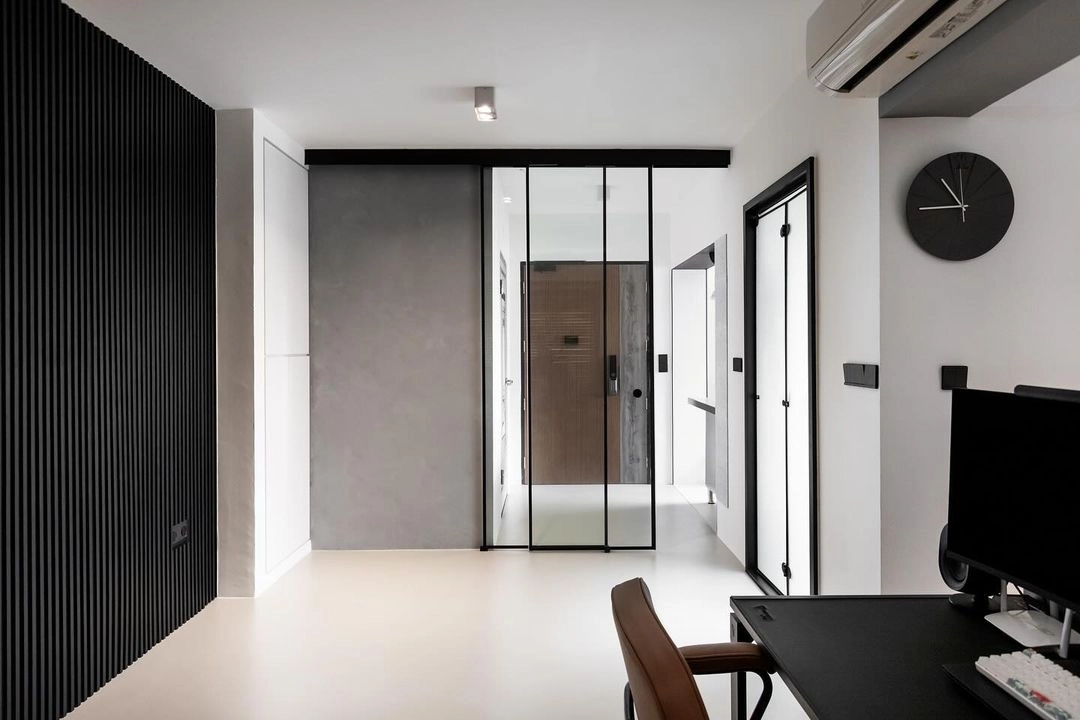
Walk into any newly renovated BTO or a curated landed home in Singapore, and you are likely to see it: a seamless, velvety expanse of grey flowing from the living room into the open-concept kitchen, uninterrupted by grout lines or visual noise. It promises a home that feels grounded, architectural, and effortlessly calm. It is a canvas that lets the furniture and the people within the space truly shine.
But as with any profound design choice, there is the dream, and then there is the reality of living with it.
At Floor Xpert, our journey with flooring has always been about more than surfaces. It is about how a home feels to the people who wake up in it every day. We used to carry authentic microcement. We’ve installed it. We saw what happened to it over time in Singapore’s humid conditions. That experience, and our deep respect for the artistry the material demands, is what informs everything that follows.
If you are captivated by the industrial charm of microcement, this guide is your honest companion on what the material truly is, the myths that surround it, and the engineered evolutions that might just be the wiser foundation for your future memories.
What Is Microcement and Why Does It Look the Way It Does?
To understand the allure, you have to look beyond the colour. Authentic microcement is not simply concrete poured on a floor. It is a sophisticated, architectural skin.
Technically, it is a cement-based composite coating applied thinly, usually just 2 to 3 millimetres, over a variety of surfaces. A complex blend of high-performance cement, water-based resins, additives, and mineral pigments. Unlike the brutalist weight of traditional industrial floors, microcement is delicate and refined.
Its primary appeal is continuity. Because it does not require expansion joints, it can cover large floors, walls, and even joinery — a kitchen island, a bathroom wall, a built-in wardrobe — in a single, unbroken sweep. It creates a visual silence that makes Singapore’s compact spaces feel significantly larger.

The hand-trowelled texture and natural variation that make authentic microcement impossible to mistake — and is almost impossible to manufacture without skilled hands.
Knowing the differences:
In your research, you will encounter similar terms. The look may be similar, but the life cycle is very different.
- Cement Screed: The raw mix of cement and sand, also known as the OG industrial floor. Thick (30–50mm), dusty, and prone to structural cracking. More “foundry” than home.
- Micro Concrete: Similar to microcement but engineered to be thicker and more robust. Reserved for high-traffic commercial spaces and industrial lofts, not intimate residential settings.
- Epoxy Flooring: A resin-based liquid poured and cured. Extremely durable and waterproof, but lacking the organic soul of cement, it tends toward glossy and plastic, missing the natural cloudy variation that makes cement so alive.
Is Microcement Waterproof, Crack-Resistant, and Cheaper Than Tiles?
There is a romanticism about microcement that obscures the technical reality — and in the microcement vs vinyl in Singapore conversation, these myths come up constantly. We hear homeowners repeat advice from renovation forums that is simply not accurate. Here is what is true:
“Microcement is flexible, so it never cracks.”
False. While microcement has elastic properties that make it more forgiving than standard concrete, it is not invincible. It is a skin, and like human skin, it moves with the body beneath it. If your subfloor moves, which is common in newer Singapore developments due to building settlement and temperature fluctuations, the microcement mirrors that movement. Hairline cracks are not a manufacturing defect. They are an inherent characteristic of the material, and under Singapore’s conditions, they are a near certainty over time.
“Microcement is naturally waterproof.”
True, but with a critical catch. The cement mixture itself is porous. It relies entirely on a top-layer sealer to repel water. Think of it like a raincoat: as long as the coat is intact, you are dry. But if that sealer wears in high-traffic areas or gets scratched by a dragged chair, the protection breaks down. Water penetrates, leading to dark, damp patches trapped beneath the surface — in Singapore’s humidity, this can result in patchiness and spread throughout the floor.
“Microcement is cheaper than tiles because you don’t need to hack.”
False, and this is perhaps the biggest misconception we encounter. Authentic microcement is an artisanal product. In Singapore, professional installation costs $20–$30+ per square foot, which is significantly more than mid-to high range luxury vinyl ($7–$10+ PSF) and competitive with premium porcelain tiles. You are paying for the time and the hand of the artist: skilled craftsmen applying layer upon layer by hand, waiting for each to cure, then sanding and sealing. That is not a budget choice. It is a premium one.
The resealing reality: Microcement requires a maintenance coat of sealer every 2–5 years in Singapore’s conditions, or sooner if the surface sees heavy foot traffic. This is not optional — it is what keeps the floor performing. Factor this into the long-term cost before deciding.

Multiple layers, applied and cured by hand. This is why authentic microcement costs $80–$150+ PSF installed — you are paying for the hours and the expertise.
Does Microcement Work in Singapore’s Humidity and Wet Bathroom Culture?
We must talk about where we live, because a material that performs beautifully in a dry Mediterranean villa faces fundamentally different challenges here.
The wet bathroom reality:
In Singapore, we value hygiene. We wash our bathrooms, we scrub them, we use strong cleaning products. Authentic microcement is undeniably beautiful, but it is also delicate. Harsh chemicals like bleach, or stiff scrubbing brushes, strip the protective sealer. Once that barrier is gone, water ingress begins. In our humid climate — averaging 84% relative humidity year-round — trapped moisture beneath the surface leads to bubbling, delamination, or mould growth. We have seen this, and it is not rare.
The thermal reality:
Cement is a conductor. It draws heat away from whatever touches it. In a Singapore bedroom with air-conditioning running through the night, walking barefoot on microcement in the morning feels startlingly cold — even in a tropical country where the floor should be one of the warmer surfaces in the home. For a space meant to feel like a sanctuary, this lack of thermal comfort can make the room feel clinical rather than welcoming.
The maintenance reality:
In Singapore’s open-concept living arrangements where the kitchen flows into the dining area, which flows into the living room, microcement’s seamless quality is its greatest visual asset. But that same seamlessness means that when one section is compromised, the repair is visible across the entire flow. Spot-patching authentic microcement without leaving a mark is almost impossible.
This is not an argument against microcement. It is an honest account of what living with it in Singapore actually looks like.

Singapore's wet bathroom culture, where the entire floor becomes a wet zone, is one of the most demanding environments for any surface sealer.
What Are the Best Microcement Alternatives for Singapore Homes?
It was this tension between the deep desire for the aesthetic and the practical need for livability that led us to make a decision. We stopped carrying authentic microcement, not because we lost respect for it, but because we found materials that deliver the same design intention with a fundamentally better long-term relationship with Singapore’s conditions.
These are not imitations. They are engineered evolutions, and the right answer in the microcement vs vinyl in Singapore decision depends entirely on how you actually live.
Microcement Vinyl
For the homeowner who loves the aesthetic but cannot afford the anxiety, Microcement Vinyl is the revelation.
High-definition printing technology on Luxury Vinyl Tiles now captures the cloudy, hand-trowelled texture of cement with startling realism; not the repetitive, obviously printed patterns of earlier vinyl generations, but something genuinely convincing at floor level.
- Why it works: The visual silence of concrete, with a 100% waterproof guarantee. You can mop it, spill on it, and live on it without the sealer anxiety that authentic microcement requires.
- The experience: Softer underfoot than real cement, which reduces fatigue during long hours in the kitchen. The seamless flow you want, together with the durability that stands up to children, pets, and Singapore’s everyday demands.
- The honest trade-off: It does not feel like stone underfoot. Nothing printed on vinyl fully replicates the thermal mass and slight surface irregularity of real cement. For homeowners who touch their floors as much as they look at them, this matters.

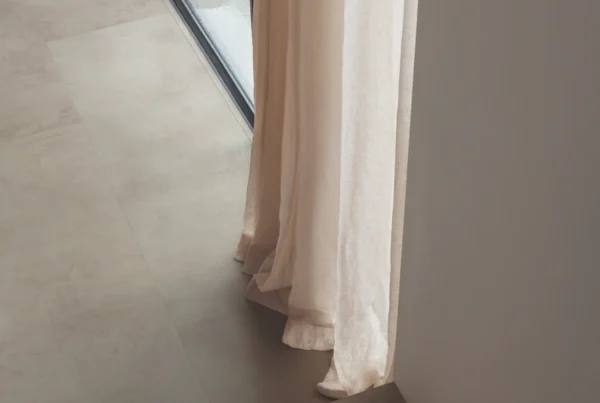
Floor Xpert's microcement-look vinyl: the same visual silence as authentic cement, with a 100% waterproof surface and no resealing requirement.
Hybrid Wood Flooring with Microcement Look
This is for the tactile homeowner. If the Wabi-Sabi philosophy is what drew you to microcement with the organic, alive, imperfect quality of the surface, Hybrid Wood Flooring is the closer match in spirit, if not in appearance.
- The innovation: A new generation of laminate with a 100% watertight surface technology. The matte, textured finish mimics the moody restraint of microcement without cement’s maintenance demands.
- The feeling: Because it is constructed with a High-Density Fiberboard(HDF) core, it retains ambient temperature. Step out of bed in the morning, and it does not shock your feet. It is solid, warm, and acoustically soft. It provides the look of a considered loft, but the feeling of a home that welcomes you back.
- The honest trade-off: It does not have the seamless wall-to-floor continuity of authentic microcement. Grout lines are present. For homeowners who want every surface to flow as one unbroken material, vinyl is the closer match.

Hybrid Wood Flooring retains ambient temperature — the quality that makes the difference between a floor you admire and one that welcomes you home.
Microcement vs Vinyl vs Hybrid Wood in Singapore: How They Perform in Real Life
Choosing a floor is not just about choosing a colour. It is choosing how you will live with a surface for the next decade, so here is how these three materials perform in the moments that matter.
Scenario A: Barefooted mornings.
- Authentic Microcement: Cool to the touch, even in Singapore, so the aircon effect is real. Visually stunning in morning light and shows off its handcrafted depth.
- Microcement Vinyl: Neutral temperature, smooth and easy underfoot.
- Hybrid Wood: Warm for a gentle start to the day.
Scenario B: Spilled wine, coffee, or a child’s lunch.
- Authentic Microcement: Act immediately. The acid in wine or coffee can etch the sealer or, worse, stain the porous cement beneath if the sealer has already thinned.
- Microcement Vinyl: No urgency and fully impervious to liquids. Wipe when you get to it.
- Hybrid Wood: Safe; the watertight surface technology beads the liquid, giving you time without swelling.
Scenario C: Five years of daily life.
- Authentic Microcement: Will carry a patina, with hairline cracks in high-traffic zones, worn spots near the sink and entrance, and a sealer that needs professional renewal. Whether this reads as beauty or deterioration depends entirely on the homeowner’s philosophy.
- Microcement Vinyl: Largely unchanged. The wear layer protects the print from fading or surface scratching under normal residential use.
- Hybrid Wood: Similarly, largely unchanged and maintains its matte integrity. No resealing required.
Scenario D: The Singapore bathroom.
- Authentic Microcement: Not recommended for Singapore’s wet bathrooms. The surface sealer is only half the equation, as water also penetrates from below if the subfloor waterproofing membrane is inadequate. In a wet bathroom that is regularly hosed down, both attack vectors are constantly active. Even with meticulous maintenance of the top sealer, subfloor moisture ingress is a genuine risk. Tiles with a proper waterproofing membrane beneath are the right specification here.
- Microcement Vinyl: Also not appropriate for Singapore’s wet bathrooms. While the surface itself is waterproof, water regularly reaches the joints and, in a truly wet bathroom, the subfloor. Vinyl does not replace the waterproofing membrane that a wet zone requires beneath the floor. Use tiles.
- Hybrid Wood: Not suitable for any bathroom with wet zone exposure. The HDF core, despite its watertight surface technology, is not engineered for the sustained moisture environment of a Singapore wet bathroom. Bedrooms and living areas only.

The visual difference between these three surfaces is subtle in photography. The difference in how they perform over five years in a Singapore home is not.
Which Foundation Tells Your Story?
There is no wrong choice, only the choice that fits how you actually live.
Choose Authentic Microcement if you are a purist who views the floor as art. You accept hairline cracks, sealer maintenance, and surface evolution as part of the material’s character, much like a leather bag that ages with the person who carries it. You have a skilled installer you trust, and you understand that this is a floor you will actively tend.
Choose Microcement Vinyl if you want the industrial look without the maintenance. You need a surface that performs across wet and dry zones, stands up to children and pets, and asks nothing of you except an occasional mop. Utility and honesty over romanticism.
Choose Hybrid Wood Flooring if you want your home to feel like a cocoon. The visual edge of the industrial aesthetic, but the physical warmth and acoustic softness that make a space feel genuinely lived in, along with the benefits of choosing a sustainable material. You want a floor that welcomes you, not one you have to treat with care every time you walk across it.
Also Read: 5 Tips To Choose The Ideal Flooring Contractor In Singapore
Frequently Asked Questions: Microcement in Singapore
How much does microcement cost in Singapore in 2026?
Professional microcement installation in Singapore typically costs $20–$30+ per square foot, making it one of the most expensive flooring finishes available. This includes material, skilled application (multiple layers applied and cured by hand), and the initial sealing coat. It does not include the cost of resealing every 2–5 years, which should be budgeted as an ongoing maintenance expense. Microcement-look vinyl, by comparison, costs $7–$10+ PSF installed.
Can microcement be used in a Singapore wet bathroom?
No, and neither can microcement vinyl or Hybrid Wood Flooring. This is one of the most common misconceptions we encounter. Authentic microcement is vulnerable to the top sealer degrading under Singapore’s wet bathroom conditions — but even if the sealer holds, water also penetrates from below if the subfloor waterproofing membrane is insufficient. In a true wet bathroom that is regularly hosed down, moisture attacks from both directions simultaneously. Microcement vinyl has a waterproof surface, but does not replace the subfloor waterproofing membrane a wet zone requires, and water still reaches the joints under wet bathroom conditions. Hybrid Wood Flooring’s wood-based core is not engineered for sustained moisture exposure. For Singapore wet bathrooms, tiles with a properly installed waterproofing membrane beneath are the only appropriate specification, and what we always recommend.
What is the difference between microcement and microcement vinyl?
Authentic microcement is a cement-based coating applied by hand in multiple layers by a skilled craftsman. It is porous and requires a sealer to repel water. Microcement vinyl is a luxury vinyl tile with a high-definition printed surface that replicates the cement aesthetic, and it is 100% waterproof by construction, requires no sealing, and is significantly less expensive. The visual difference at floor level is subtle with quality vinyl products; the difference in maintenance commitment is significant.
Is microcement suitable for HDB flats in Singapore?
Technically yes, but with important caveats. HDB flat subfloors are subject to building movement and settlement, particularly in newer developments, which increases the likelihood of hairline cracking in microcement over time. For HDB applications where the microcement aesthetic is desired, microcement-look vinyl installed with an acoustic underlay is a more practical specification.
How long does microcement last in Singapore?
Authentic microcement, professionally installed and maintained with resealing every 2–5 years, can last 5–10 years in Singapore’s residential conditions. However, its appearance changes over time, so hairline cracks, worn areas in high-traffic zones, and surface patina are to be expected. Homeowners who embrace this evolution find it beautiful. Those who expect the surface to look like installation day after five years will be disappointed. Microcement vinyl, by comparison, maintains its appearance significantly longer under normal residential use with minimal maintenance.
Come Feel the Story
Words may describe the look, but only your hands can understand the texture.
We invite you to let go of past perceptions and past assumptions about what these materials feel like and experience them directly. Walk on the floors barefoot, feel the warmth of the Hybrid Wood against the neutrality of the Vinyl. Understand, in your senses, what the difference between a floor you admire and a floor you live on actually means.
The microcement vs vinyl Singapore decision is ultimately not about which material is better — it is about which one fits how you actually live. The foundation that tells your story best is the one that still feels right five years from now.