In Singapore, SPC vs vinyl flooring is one of the most misunderstood comparisons in renovation because most homeowners don’t realise they are choosing between two fundamentally different materials, not two versions of the same thing. Here is the confusion most Singapore homeowners run into: many people assume SPC is simply a type of vinyl flooring.
In reality, they are distinct materials that feel, perform, and suit spaces quite differently. Choosing the wrong one for the wrong room is one of the most common flooring mistakes we see.
This guide explains what actually separates them and where each one belongs in a Singapore home. It also reveals the one thing other comparison articles won’t tell you: why we no longer recommend traditional SPC for most residential applications — and what has replaced it.
What Is the Difference Between SPC and Vinyl Flooring?
Both SPC and LVT vinyl flooring do not belong to the same category. Both are waterproof at the surface, both come in wood and stone designs, and both are significantly more affordable than natural timber or stone. However, the distinction is in the core—the material that sits beneath the surface layer and determines how the floor feels, sounds, and performs.
There are actually three distinct products worth understanding before making a decision, and most comparison guides only cover two of them.
Traditional Luxury Vinyl Tile (LVT)
The first generation of vinyl flooring. The core is flexible PVC, giving it a soft, warm, and acoustically quiet feel underfoot. Its key strength is minimal thermal expansion, as LVT requires only a 2mm expansion gap, making it dimensionally stable and forgiving in Singapore’s temperature-cycling conditions. The trade-off: flexible LVT is more susceptible to dentation under heavy point loads like furniture legs and high heels.
Stone Plastic Composite (SPC)
A completely different material, which is limestone-based. The rigid stone composite core makes it highly scratch-resistant and waterproof, well-suited to commercial environments and heavy-traffic zones. The weaknesses are real: it is hard, cold, and noisy underfoot. SPC also has higher thermal expansion than LVT, requiring larger expansion gaps during installation. For residential Singapore homes, particularly bedrooms and living areas, these trade-offs matter daily.
Quick-Step LURF® Premium
Floor Xpert’s current flagship vinyl. LURF® combines a rigid PVC core with LVT construction in a multilayer system that is engineered to deliver the best of both materials. It has the softness and acoustic warmth of LVT on the surface, the stability and waterproofing of a rigid core, and minimum dentation susceptibility. The one honest trade-off: it sits at a slightly higher price point than traditional LVT. For most Singapore homes, it is the specification we recommend.
The structural difference is now clear with three materials and three different performance profiles, not one category with minor variations.

The core is everything. Our LVT (left) uses an advanced PVC construction, while our SPC (right) uses a rigid stone composite. These are different materials that deliver completely different feels underfoot.
How Do SPC and Vinyl Flooring Actually Feel in a Singapore Home?
This is the question that gets answered least honestly in most comparison guides, but here is what we actually observe from installing both in Singapore homes:
Underfoot comfort
LVT is softer and warmer. In a bedroom where you step barefoot every morning after air-conditioning has run all night, LVT feels like a floor that welcomes you. SPC, in the same conditions, can feel cold and hard. It is noticeable enough that some homeowners end up placing rugs in areas where they originally didn’t want them.
This distinction becomes more than a comfort preference for households with young children or elderly family members. A fall on SPC hits harder than the same fall on LVT, in the same way that falling on concrete feels different from falling on a wooden floor. For Singapore’s many multi-generational households where grandparents and young children share the same living space, this is a genuine safety consideration that most flooring guides don’t address.
Acoustics
LVT absorbs footstep sound better. SPC, being rigid, transmits more sound. Footsteps can echo slightly, particularly in upper-floor HDB or condo units where impact noise matters. If you have young children or are conscious of noise for neighbours below, LVT performs better acoustically without requiring additional acoustic underlay.
Subfloor tolerance
Both LVT and SPC require a properly levelled subfloor, so this is non-negotiable for either material. However, the way unevenness manifests differs meaningfully between the two. With LVT, minor subfloor imperfections translate into a surface you can feel underfoot. This means slight undulations that register through the flexible material but without any hollow sound. With SPC, the rigid core bridges unevenness, and the surface feels visually flat, but the air gap beneath it creates a hollow sound when walked on. Neither outcome is acceptable in a properly prepared installation. In older Singapore HDB flats where existing tile surfaces may have minor unevenness, levelling before installation is critical for both materials.
Dimensional stability
On dimensional stability, LVT is actually the more stable material. This is a point that surprises most homeowners. Flexible LVT has lower thermal expansion and requires only a 2mm expansion gap, making it more forgiving in Singapore’s open-plan homes where areas near doors and windows experience temperature variation throughout the day. SPC’s rigid core has higher thermal expansion, requiring larger expansion gaps during installation. In rooms with significant sun exposure or temperature cycling, this matters. It is one of the reasons LURF®’s multilayer construction, which combines rigid-core stability with LVT’s lower expansion characteristics, performs better in real Singapore residential conditions than traditional SPC.

The difference between LVT and SPC isn't visible, but felt. In Singapore's air-conditioned bedrooms, it matters every morning.
Where Each Material Belongs in a Singapore Home
The right choice depends on the room, not on which material is generically better. Here are our recommendations for different applications:
| Space | Recommended | Reason |
| Master bedroom | LVT | Barefoot comfort, warmth, acoustics |
| Children’s bedroom | LVT | Softer underfoot, safer falls, sound absorption |
| Elderly family member’s room | LVT | Falls on SPC’s rigid core are significantly harder; LVT reduces injury risk |
| Living room (multi-generational home) | LVT | Where children play and elderly walk most, so comfort and fall safety both apply |
| Living room (adults only) | Either | LVT for comfort priority, SPC for heavy-furniture layouts |
| Study room | LVT | Comfort during extended chair use |
| Kitchen | Either | Higher traffic, some moisture exposure, durability priority |
| HDB corridor | Either | Traffic durability |
| Commercial space | Either | Traffic durability |
| Wet bathroom | Neither; use tiles | No vinyl or SPC system is appropriate for Singapore wet bathrooms |
The one place we see homeowners consistently make the wrong choice is the bedroom. SPC is frequently sold as the more premium option because of its higher specification, but in a bedroom, those commercial-grade specifications are irrelevant. You don’t need impact resistance and dimensional stability in a room where the primary activity is sleeping and walking barefoot. You need warmth and comfort, so LVT is the right material for that.
The Terminology Problem And Why It Matters for Singapore Homeowners
Here is something most comparison guides skip entirely: the flooring industry’s terminology is inconsistent, and it causes real confusion.
Many Singapore suppliers label their products simply as “SPC vinyl flooring” or “vinyl SPC”, using both terms interchangeably to describe the same product. Some products sold as “vinyl flooring” have rigid SPC cores. Some products sold as “SPC” have more flexible constructions than traditional stone composite. The label on the box doesn’t always tell you what you’re actually buying.
What to ask instead of relying on the category name:
- What is the core made from?
- What is the acoustic performance with or without underlay?
- What is the international usage class rating?
- How does it feel underfoot? Can I try walking on it barefoot in the showroom?
That last question is the simplest quality test available. Walk on the floor barefoot in the showroom—if it feels cold and hard and you’re buying it for a bedroom, reconsider.
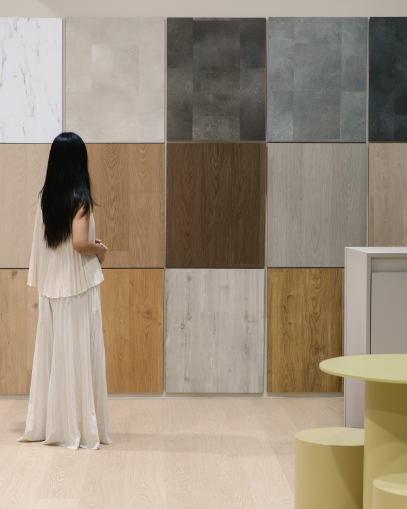
The only reliable test is also the simplest one. Go barefoot and walk on both in the showroom! Your feet will tell you what the spec sheet can't.
Why We No Longer Recommend Traditional SPC for Most Singapore Homes
We need to be direct about something that most flooring guides won’t say: traditional SPC, the rigid stone composite product that dominated Singapore’s market in the past, has largely been superseded by better technology.
Quick-Step, our manufacturer from Belgium, developed the rigid core Vinyl (called LURF®) precisely to address SPC’s limitations. Rather than a stone-powder rigid core, our Vinyl uses an advanced rigid PVC that achieves SPC’s dimensional stability and water resistance while recovering the acoustic warmth and underfoot comfort that stone composite loses.
In practical terms, our Quick-Step Vinyl performs like premium SPC in the areas where SPC excels. This includes stability, durability, and waterproof performance, while feeling more like quality LVT in the areas where SPC historically underperformed, such as acoustic comfort, thermal warmth, and underfoot softness.
For Singapore homes specifically, where barefoot living and air-conditioned bedrooms are the norm, this distinction matters considerably. We still carry and install both flexible and rigid-core options of LVT. But when homeowners ask us which we would put in our own homes, the answer is consistently the evolved rigid vinyl and not the traditional SPC category.

Quick-Step LURF® — the evolved rigid vinyl that delivers SPC's stability without its acoustic and thermal compromises. Available at Floor Xpert.
SPC vs Vinyl Flooring Singapore: The Honest Comparison Table
| Factor | LVT Vinyl | Traditional SPC | Quick-Step LURF® |
| Core | Flexible PVC | Rigid stone composite | Advanced rigid PVC (multilayer) |
| Underfoot feel | Soft, warm | Hard, cold | Soft and acoustically warm |
| Acoustics | Good | Lower, more echo | Good, comparable to LVT |
| Waterproof | Yes | Yes | Yes |
| Dentation resistance | Lower, susceptible to furniture dents | Higher | Minimum dentation |
| Thermal expansion | Low, 2mm expansion gap only | High, larger expansion gap required | Low, stable like LVT |
| Stability | High | Moderate | High |
| Singapore wet bathroom | Not suitable | Not suitable | Not suitable |
| Best for | Bedrooms, studies, living areas | Commercial, high-traffic zones | Bedrooms, studies, living areas, kitchens |
| Typical installed cost (PSF) | $6–$10+ | $8–$12+ | $7–$10+ |
What to Watch Out for When Comparing Quotes
When you receive quotations from different suppliers for SPC or vinyl flooring in Singapore, several factors significantly affect the final cost and outcome. Here are some tips on what to watch out for:
Wear layer thickness is the most commonly misrepresented specification, and thickness alone is not a reliable indicator of durability. The wear layer is the transparent protective surface above the design print that determines how long the floor maintains its appearance under daily use. Many homeowners are told to simply compare millimetre measurements, but a 0.5mm wear layer from a low-quality manufacturer can wear down faster than a 0.3mm wear layer from a premium one. The composition of the floor, the manufacturing process, and the overall product quality determine real-world performance, not just the numbers on the spec sheet.
Usage class is the most reliable durability indicator. Classes 31 and 32 are the standard requirements for residential use. Class 33 and above indicates a commercial specification, which is relevant if you are installing in a café or office. Ultimately, the usage class tells you what the product was actually tested for, not just what looks impressive on a brochure.
Acoustic underlay is frequently omitted from base quotations and added as a surcharge after you’ve committed. For HDB installations in particular, acoustic underlay may be necessary; ask whether it’s included in the quoted price before comparing numbers.
Also Read: 5 Tips To Choose The Ideal Flooring Contractor In Singapore

The numbers on the spec sheet tell you one thing, but who made the floor—and how—tells you everything else.
Frequently Asked Questions
Is SPC flooring better than vinyl flooring for Singapore homes?
SPC and LVT vinyl are distinct materials, so the question is really which one suits your specific space and household. For commercial areas and high-traffic zones, SPC’s rigidity makes it appealing. For bedrooms, living areas, and study rooms, particularly in households with young children or elderly family members, LVT vinyl offers better acoustic performance, underfoot comfort, and fall safety. Quick-Step LURF® Vinyl bridges both worlds, delivering SPC-level stability with LVT-level comfort, making it our recommendation for most Singapore residential applications.
What is the difference between SPC and LVT flooring?
SPC (Stone Plastic Composite) and LVT (Luxury Vinyl Tile) are entirely distinct materials. They have different cores, feel different underfoot, and belong in different spaces. SPC is built on a rigid core of limestone powder, PVC, and stabilisers. Because it is so hard, it excels in commercial environments and heavy-traffic zones. LVT uses a flexible PVC core, making it softer, warmer, and significantly better at absorbing sound. It is also more forgiving over minor subfloor imperfections. While both feature waterproof surfaces and realistic wood or stone designs, they perform very differently in a Singapore home, especially when it comes to comfort, acoustics, and safety for kids or elderly family members.
Is SPC flooring safe for households with young children or elderly family members?
This is one of the most important questions Singapore homeowners with multi-generational households should ask and one that most flooring guides skip entirely. SPC’s rigid stone composite core has virtually no give. A fall on SPC hits harder than the same fall on LVT vinyl, for the same reason that falling on concrete feels different from falling on a softer surface. For young children who fall regularly, and for elderly family members where a fall carries genuine injury risk, LVT is the safer and more appropriate choice. Singapore’s multi-generational living arrangements, where grandparents and grandchildren frequently share the same home, make this consideration more relevant here than in most markets. We always raise it when households describe their living situation to us. If there are elderly residents or young children in the home, we recommend LVT throughout the living areas, bedrooms, and any space where they spend time on the floor.
Can SPC or vinyl flooring be used in Singapore wet bathrooms?
No, neither SPC nor LVT vinyl is appropriate for wet bathrooms in Singapore. Both materials have a waterproof surface, but Singapore wet bathrooms, where the entire floor is regularly hosed down, expose the flooring joints and subfloor to sustained moisture in ways that vinyl and SPC systems cannot manage reliably. For Singapore wet bathrooms, tiles with a proper waterproofing membrane beneath the substrate remain the only appropriate specification.
How long does SPC flooring last in Singapore?
Quality SPC flooring from a reputable manufacturer, professionally installed with proper subfloor preparation, typically lasts for years in Singapore residential conditions. Longevity depends more on overall product quality and manufacturing standards than on any single specification, such as wear layer thickness. The most common cause of early failure in Singapore is not the material itself but inadequate subfloor preparation; SPC’s rigidity means it bridges rather than conforms to subfloor imperfections, leading to hollowing, joint stress, and eventual failure if levelling is skipped.
Is SPC flooring suitable for HDB flats in Singapore?
Yes, with two important considerations. SPC’s rigid core transmits more impact sound than vinyl, making acoustic underlay selection more critical for SPC than for LVT. Second, SPC requires a properly levelled subfloor; its rigidity is an asset in stable conditions but becomes a liability over uneven surfaces. Have your installer assess the subfloor before specifying materials.
Feel the Difference
The SPC versus LVT distinction is one that no article can fully convey because it is ultimately a sensory distinction, not a specification one. The numbers on a product sheet will not tell you whether a floor feels right in your home.
Come and walk on our LVT barefoot. Bring the floor plan of your space if you have it, and we will tell you honestly which material belongs in which room, and which to avoid.