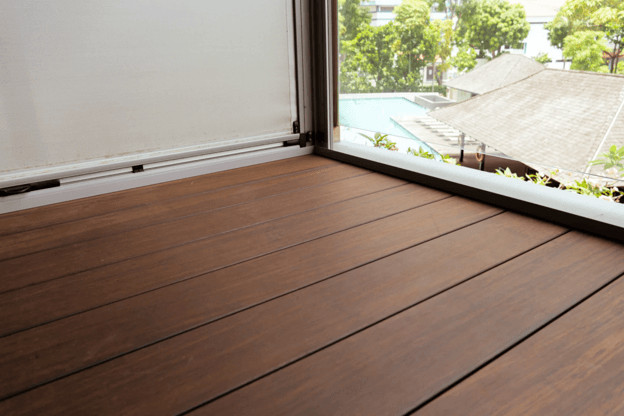
WPC composite decking installed on a condo balcony in Singapore, showing warm brown board finish and clean board lines beside a sliding door overlooking a pool.
Summary:
- Singapore’s humidity and rainfall cause timber decking to swell, crack, warp, and develop mould faster than in temperate climates.
- WPC decking requires no sanding, resealing, or staining. Routine cleaning with water and mild soap is sufficient to maintain its appearance.
- WPC costs more upfront, but when timber maintenance is included, the 10-year total is often comparable or lower with composite.
- Timber remains a worthwhile choice if you value natural character and will actively maintain it. Carbonised bamboo offers a more durable natural alternative with lower upkeep demands.
- Substructure cost and a realistic maintenance estimate are the 2 figures most often missing from quotes. Both change the comparison significantly.
Composite or Timber Decking: Which Is Worth It in Singapore?
Choosing between composite and timber decking in Singapore is not simply a question of cost or appearance. It is a question of what each material does under sustained heat, humidity, and near-daily rainfall, and what that means for maintenance and total spend over time.
The difference shows up in year 2 or 3, when upkeep schedules and board condition start to diverge. This guide works through that comparison in practical terms, including what to ask for in any quote before committing.
Does Singapore’s Climate Shorten the Life of a Timber Deck?
Yes. Singapore’s year-round humidity and near-daily rainfall accelerate the degradation of natural timber considerably faster than in temperate climates.
Timber decking holds up well during installation. Within a few monsoon seasons, surface greying, cracking along the grain, and mould growth in pooling areas are common.
Natural wood is a porous material. It absorbs moisture, expands, dries out, and contracts. In a temperate climate, this cycle is gradual. In Singapore, where humidity is consistently high and heavy rainfall occurs across much of the year, this cycle repeats continuously.
Over time, this causes:
- Surface cracking along the wood grain as fibres repeatedly swell and shrink
- Warping or cupping of boards, particularly at joints and edges
- Greying and surface degradation from UV exposure
- Mould and algae growth in shaded areas or wherever water sits after rain
- Softening or rotting in boards that do not receive adequate drainage or airflow.
If your outdoor space is fully exposed to the elements or sits near a pool or planter box, this is not a distant concern. It is something most wood decking owners in Singapore encounter within the first few years, and it shapes the ongoing time and cost commitment the deck demands.
What the Maintenance Difference Between WPC and Timber Actually Looks Like
Wood plastic composite (WPC) decking in Singapore combines wood fibre with polymer materials, producing a surface that does not absorb moisture in the way natural timber does. It was developed to address the failure points that tropical climates expose in natural wood. Singapore’s humidity and rainfall make those differences material.
The zSNAP.DECK:WPC range, for example, is engineered from wood fibre and 30% recycled plastics. It resists fading, staining, scratching, and mould. The maintenance difference compared to timber is significant in practice:
| Maintenance Task | Timber Decking | WPC Decking |
| Sanding | Required | Not required |
| Resealing or restaining | Periodically required | Not required |
| Mould treatment | Periodic | Rarely needed |
| Routine cleaning | Dependent on material, some require specialist products | Water and mild soap |
| Board replacement | As boards degrade | Individual boards accessible |
No specialist products or professional cleaning schedule is required to keep a WPC deck in good condition.
zSNAP.DECK uses an Invisible Profile system, an asymmetric overlapping joint that hides the locking mechanism while still allowing water and air to pass through beneath the boards. This reduces debris and moisture accumulation under the deck surface, limiting the build-up that shortens a deck’s useful life.
Maintenance costs are the figure most often left off a decking quote. Before committing to a material, see both composite and timber options in person at the floorxpert showroom. Explore our outdoor decking range and speak to the team about what suits your specific space.
Is Composite Decking Worth the Higher Upfront Cost?
For most outdoor spaces in Singapore, yes. When the full cost of timber maintenance is accounted for over time, the price gap between the 2 materials narrows considerably.
Composite decking carries a higher upfront price than most timber options. For many homeowners, that gap is enough to give pause, especially when timber looks just as appealing in a showroom or product photograph.
The more relevant comparison is not which material costs less on day one, but which costs less over a decade of ownership.
The table below puts that comparison in concrete terms, reflecting typical outdoor decking cost ranges in Singapore. Final pricing varies based on area size, substructure choice, site conditions, and installation complexity.
| Material | Typical Cost (per sq ft) | Expected Lifespan | Ongoing Maintenance Cost |
| Timber decking | Lower–Moderate | 2–10 years (with upkeep) | Higher (sealing, repairs, replacement) |
| WPC composite decking | Moderate–Higher | Up to 10 years | Lower (minimal intervention required) |
zSNAP.DECK is designed to perform well, and carries up to a 10-year warranty. The total cost of ownership over a decade works out to be comparable or lower with composite once timber’s ongoing maintenance costs are included.
When requesting a quote for any outdoor decking project, ask your installer to cover each of the following:
- Board cost, including material type and quantity
- Substructure material (aluminium or timber frame) and associated cost
- Installation labour
- For timber: a realistic estimate of routine maintenance and likely repairs over the first 5 years.
That last item is the one most often left off a quote. Including it gives you a realistic picture of the total cost over time, not just the cost of installation.
Timber Remains a Practical Choice for the Right Project
Composite decking performs well in Singapore’s climate, but it is not the right fit for every project. Timber remains a practical choice for homeowners who prioritise the character of natural materials and are prepared to maintain the deck accordingly.
The grain, texture, and warmth of real timber produce an aesthetic that engineered materials approach but do not fully replicate. For homeowners where that distinction matters, it is a reasonable basis for the decision.
Timber tends to be the right call when:
-
- You value the aesthetic of natural materials and the character that comes with how wood ages over time.
- Your outdoor space is partially sheltered, which limits direct exposure and reduces the rate of weathering.
- You are committed to a regular maintenance schedule and have budgeted for it.
- The project has a defined timeframe, such as a rental property renovation, where long-term lifespan is less critical.
For homeowners drawn to natural materials but looking for a more resilient option, zSNAP.DECK:WOOD offers a middle ground worth considering:
- 100% natural, sustainable bamboo, a rapidly growing option for decking
- Treated using Carbonised Heating Technology to improve durability and resistance to the elements
- Retains the character of a natural material while being more resistant to moisture absorption, cracking, and mould that affect conventional hardwood in Singapore’s climate.
Timber in Singapore is a higher-maintenance product than WPC. It requires consistent attention to perform well over time. The key is going in with clear expectations about that commitment. It is not a set-and-forget investment.
Also Read: Composite vs Wood Decking
That distinction is personal, and it is worth working out before you choose a material, not after the installation is done. Speak to the floorxpert team and work out which one you will still be happy maintaining in year 3.
Where Does Composite Decking Perform Best in Singapore?
Composite decking is well-suited to spaces that combine high exposure, regular use, and a preference for low ongoing intervention. This covers a wide range of outdoor setups across Singapore.
zSNAP.DECK:WPC is splinter-free and insect-resistant, which makes it a practical choice across a range of applications:
- HDB and Condo Balconies: Where direct sun and rain are constants, and where the deck surface is used daily.
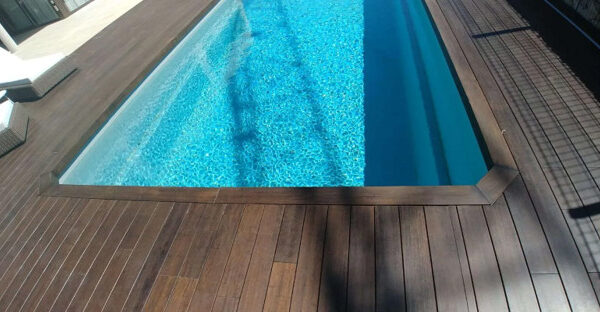
- Poolside Areas: Where wet conditions and barefoot traffic make slip resistance and mould resistance priorities.
- Rooftop Patios and Terraces: Where structural load, UV exposure, and drainage are all active concerns.
- Commercial Outdoor Seating: Where the deck faces heavy foot traffic and must remain presentable with minimal maintenance downtime.
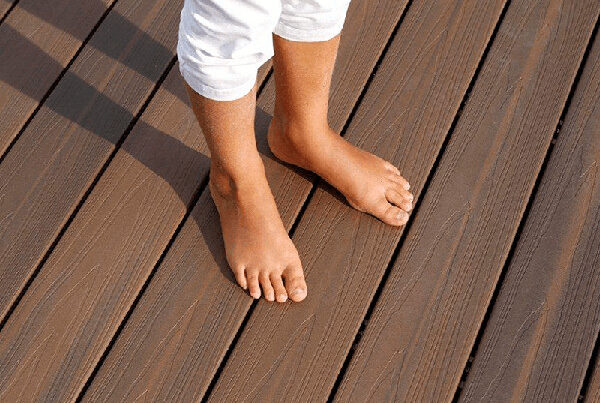
- Homes with Children or Pets: Where a safe, easy-clean surface with no risk of splinters has clear practical advantages.
2 installation features are worth understanding before you finalise your choice:
| Feature | How it works | Why it matters |
| Screw-free Magnet System | Patented aluminium substructure allows boards to expand and contract freely in response to temperature and humidity changes | Keeps the deck surface stable over time, particularly relevant for upper-floor balconies and rooftop projects where structural load and long-term integrity matter |
| 100% board accessibility | Any individual board can be lifted with a single spatula without dismantling the surrounding deck | Allows inspection, cleaning, or replacement of individual boards, practical for larger areas or configurations where future access could otherwise be disruptive |
A covered, partially sheltered balcony has different demands from an exposed garden deck or a poolside walkway. If you are unsure which product suits your specific setup, speaking to a specialist before you commit is the most reliable way to avoid a costly mismatch.
Also Read: WPC Decking in Singapore 2026: Cost, Brands & Complete Installation Guide
Find the Right Outdoor Decking for Your Singapore Project
Selecting the right outdoor decking for a Singapore space is easier when you can assess both materials in person. At the floorxpert showroom at Bras Basah Complex, you can walk on the full zSNAP.DECK range, compare finishes side by side, and speak to the team about your specific outdoor setup before committing.
Request a detailed quote for your project, or call +65 6749 3128 to speak with the team directly.