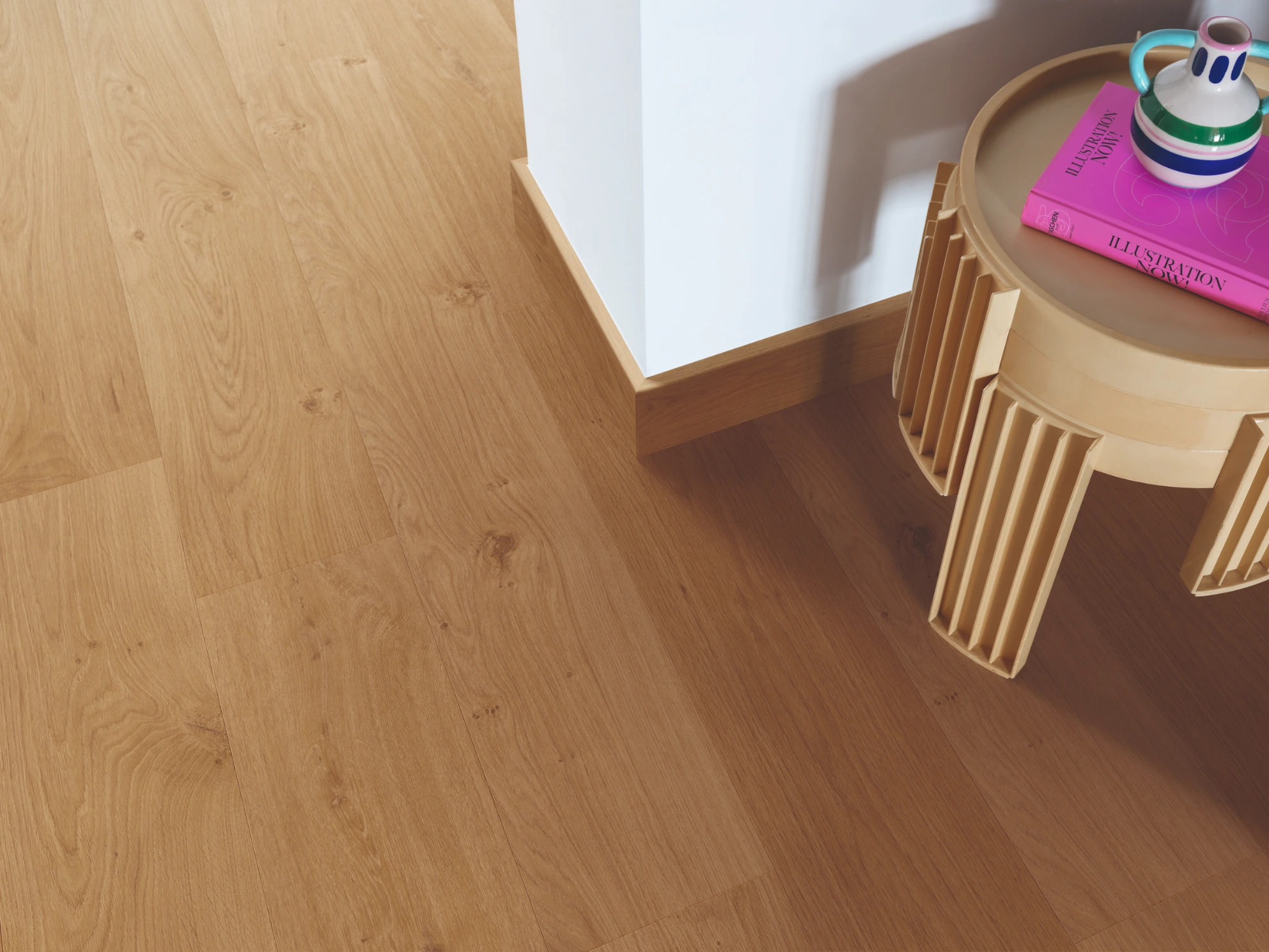
Warm honey-toned vinyl plank flooring installed in a modern Singaporean home, showing clean plank joins and skirting detail alongside a contemporary side table.
Summary:
- Choose your vinyl tile format based on your subfloor condition and how the space will be used. LVT and SPC perform differently, and the wrong choice for your conditions will show over time.
- Ask for the technical data sheet before comparing products. Material composition is a great starting point, but a thicker wear layer or plank does not always mean better quality. It is equally important to confirm that the product is manufactured from sustainable and safe materials.
- Confirm subfloor preparation is itemised as a separate line in your quotation. If it is buried in a lump sum, you cannot verify it is included.
- A lower quote that excludes disposal, levelling, and finishing trims is rarely cheaper once the job starts.
- Before signing, ask your supplier to explain their warranty terms and recommend approved cleaning methods. If they cannot, that is worth factoring into your decision.
Picture this: you have shortlisted 3 flooring suppliers, collected quotations, and chosen the one with the best price. 6 months later, the tiles are creaking, the joints are lifting, and the supplier is nowhere to be found. This is not an unusual story in Singapore’s renovation market. It almost always comes down to what was not checked before signing.
Choosing a vinyl tiles supplier in Singapore involves more than comparing price per square foot. This guide covers the 5 things most people do not check before signing: product specification, installation accountability, quotation scope, hidden costs, and aftercare support. One of these checks, subfloor preparation scope, is the most frequently omitted item from quotations and the most common source of post-renovation disputes.
Are You Comparing LVT and SPC, or Just the Price?
Before you step into a showroom or request a quotation, it helps to know that “vinyl tiles” is not a single product category. Format, core construction, and intended usage vary significantly across what is on the market. Choosing the wrong format for your conditions is one of the most common renovation regrets.
The 2 most common formats in Singapore are:
- Luxury Vinyl Tile (LVT): A flexible-core format. Comfortable underfoot and well-suited to residential spaces where warmth and acoustics matter. More sensitive to subfloor unevenness than rigid-core options.
- Stone Plastic Composite (SPC): A rigid stone-core format. Handles subfloor imperfections better and suits commercial environments where durability under load is a priority.
The Quick-Step LURF® range is a rigid-core vinyl developed to address the known limitations of traditional SPC. If you are weighing up these formats, it is worth asking your supplier about it before settling on a category.
These 2 formats behave differently underfoot, perform differently over uneven subfloors, and suit different spaces. Selecting between them depends on the specific conditions of your project, not just personal preference.
Before you go near a showroom, think about the space. Is it a bedroom that needs warmth underfoot, a kitchen that needs waterproofing at the joints, or a commercial area with heavy foot traffic where underfoot comfort is not a top priority?
Also Read: SPC Flooring vs Vinyl Flooring in Singapore
What the Specification Tells You
The specification tells you what a sample board cannot: how the tile or plank will actually perform over time. Before you look at anything else, ask about 2 things: what the product is made from, and where it was manufactured.
In Singapore, where barefoot living is the norm and spaces are often air-conditioned and enclosed, material composition matters more than most suppliers will volunteer. Look for products verified free of harmful substances such as phthalates (chemical plasticisers linked to indoor air quality concerns in enclosed spaces) and manufactured from virgin material. Ask your supplier where the product was made and by whom. A supplier who cannot answer that clearly is worth reconsidering before you go any further.
Wear layer thickness is a secondary check. A thicker wear layer from a lower-quality manufacturer can still perform worse than a thinner one from a premium product. Ask for the usage class rating alongside the millimetre figure.
The table below outlines what to look for and why it matters:
| Specification | What to Ask For | Why It Matters |
| Core certification | Phthalate-free, low VOC (volatile organic compounds), manufactured from virgin material | Directly affects indoor air quality in enclosed, air-conditioned spaces |
| Manufacturing origin | Who made it and where | Determines overall product quality and reliability of the specification claims |
| Wear layer thickness | Thicker for higher-traffic or commercial use; thinner is suitable for light residential use | A secondary indicator; assess alongside usage class rating, not in isolation |
| Water resistance | Full-body waterproof vs surface-resistant only | Important for wet areas and Singapore’s year-round humidity |
| Slip resistance | R-value or equivalent rating | Relevant for kitchens, bathrooms, and high-traffic indoor areas |
What you see on the specification sheet tells you far more than what you see on the showroom floor. Ask your supplier for the technical data sheet. If they cannot produce one, that tells you as much as the sheet itself would.
Specification sheets only tell you so much. If you want to see how a properly specified vinyl tile performs, visit floorxpert at Bras Basah Complex and ask the team to walk you through the LURF® range in person.
What Should You Know About Your Supplier’s Installation Process?
Knowing what to look for in a product is only part of the picture. How that product is installed determines whether it actually performs.
Supply and installation are not the same service, even when the same vinyl tiles supplier in Singapore offers both. A supplier can carry a well-specified product and still deliver a poor result if the installation is managed without clear accountability.
The subfloor is where most flooring problems start. An uneven surface that is not properly levelled before installation will cause hollow spots, joint stress, and creaking over time. This happens regardless of how good the tile is. Installation quality determines whether the product performs as it should. Both need to be assessed before work begins.
These are the questions worth putting to any supplier before you commit:
| Question | What to Listen For |
| Does your installation team work directly for you, or are they subcontracted? | A clear, direct answer with some explanation of how quality is managed |
| What is your process if the subfloor is uneven? | A specific answer about levelling or screeding, and how it is scoped in the quotation |
| Can you show me a completed project similar to mine? | A willingness to share references or examples |
| Who do I contact if something goes wrong after installation? | A named process, not a general reassurance |
A supplier confident in their installation process will answer all of these without hesitation. Vague responses to practical questions are a signal worth taking seriously. The condition of your floor on the day of completion depends as much on who installs it as on what they install.
Does Your Quotation Actually Cover Everything?
A clear flooring quotation should present every element of the job as a separate line item. Anything presented as a lump sum gives you no way to verify what is included and no fair basis for comparing quotes. Post-renovation disputes often have nothing to do with the product itself. They trace back to what the quotation did and did not cover.
Use this checklist to verify any quotation before you proceed:
- Material cost, with the specific product model and wear layer stated.
- Installation labour, scoped to the area being covered.
- Subfloor preparation, including levelling or screeding where required.
- Removal and disposal of existing flooring, where applicable.
- Furniture shifting, if part of the agreed scope.
- Finishing trims, skirtings and expansion joints.
These 6 items should appear as separate line entries, not folded into a single figure. After reviewing them, check for anything missing. If screeding, hacking, or disposal are not listed, ask directly whether they are included or excluded before you proceed. In older HDB flats or spaces with existing tile layers, subfloor preparation can add considerably to the total cost.
A lower figure that excludes these items is rarely the better deal once the job has started.
A quotation that looks complete on the surface can still leave out the work that matters most. Request a detailed quotation from floorxpert and see exactly what is and is not included before you commit.
Aftercare and Warranty: What to Look For
A flooring purchase is not a one-time transaction. Vinyl tiles and planks need proper care to maintain their appearance and wear layer over time. The support you receive from your supplier after installation is part of what you are paying for.
Good aftercare starts with knowing what to ask for before you commit. Look for:
- Clear warranty terms covering both the product and the installation, with durations and conditions stated.
- Guidance on approved cleaning products for the specific tile supplied. LVT is sensitive to some cleaners, which can degrade the wear layer and affect warranty coverage.
- Access to a professional floor cleaning service for periodic upkeep beyond routine cleaning, including post-renovation deep cleans and vinyl restoration.
- A clear aftercare contact, so you know how to reach them if an issue arises.
These are not exceptional standards. They are what a supplier confident in their product and installation should be able to offer. The presence or absence of aftercare support says a great deal about how seriously a supplier stands behind what they have sold you.
Warranty length is only meaningful if the issuing manufacturer is reputable. Ask who manufactured the product and where, not just what the warranty document says.
Each of the 5 areas covered in this guide points to the same question: does this supplier stand behind their work? That should be clear before you sign anything.
Also Read: Vinyl Flooring in Singapore: 2026 Prices, Types & What to Know Before You Buy
The Right Vinyl Tiles Supplier in Singapore Makes the Difference
Getting your vinyl tiles right comes down to one thing: finding a supplier who treats the job as seriously as you do. That means someone who can speak to specification, account for every line in the quotation, and still be reachable 6 months after the installation is done.
That is what floorxpert is set up to do. The LURF® range offers 100% phthalate-free, hyper-natural vinyl tiles and planks, backed by a free on-site consultation service and a professional floor cleaning service for ongoing care.
Visit floorxpert at Bras Basah Complex to see the LURF® range in person, or book a free on-site consultation if you would like us to come to you.