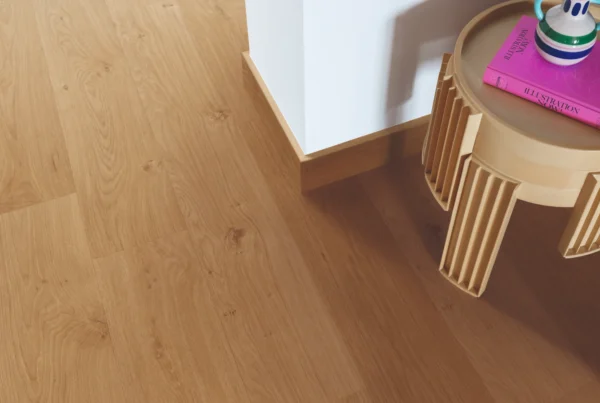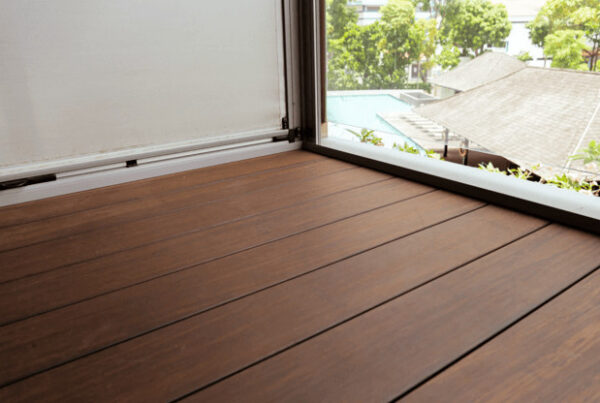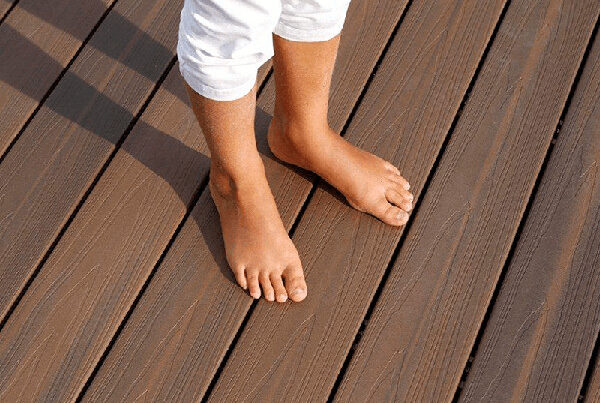
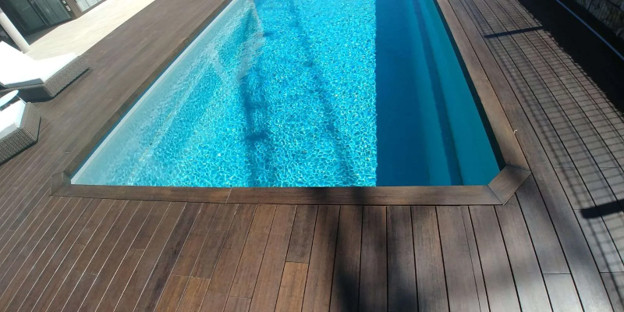
Warm-toned timber outdoor decking surrounding a residential pool in Singapore, showing close-grain plank detail and poolside installation.
Summary:
- Singapore’s UV, humidity, and rainfall degrade outdoor decking faster than most product specs account for.
- Timber damage in Singapore typically hides beneath the surface before it becomes visible, making early inspection considerably cheaper than full replacement.
- WPC decking resists rot, mould, and insects, but still requires adequate drainage and ventilation beneath the boards to perform well over time.
- In high-exposure spaces, a lower-cost timber deck replaced within 10 years typically costs more in total than a well-chosen composite selected from the start.
- Exposure type and site conditions determine both material suitability and final cost. These are the 2 variables that matter most before any quote.
Decking Guide in Singapore: Lifespan, Costs & Maintenance
Singapore’s UV index regularly reaches 10 to 11 (the extreme band on the WHO scale), and that sustained radiation combined with near-daily rainfall means outdoor timber can begin showing surface greying and coating breakdown within 2 to 3 years without consistent upkeep. The decisions made before installation determine most of what happens after it.
Why Singapore’s Climate Is Hard on Outdoor Decking
The main climate factors that affect outdoor decking durability in Singapore include:
- Sustained UV Exposure: The UV index regularly reaches the extreme band (10–11), with no winter period to slow degradation, causing unprotected surfaces to fade, dry, and crack progressively over time.
- High Ambient Humidity: Persistent humidity promotes mould, algae, and moss growth, particularly on decking with limited air circulation beneath the boards.
- Frequent Heavy Rainfall: Near-daily rainfall creates repeated wetting and drying cycles that stress surface coatings, expand and contract natural timber, and accelerate moisture ingress at joints and edges.
- Biological Activity: Warm, humid conditions accelerate organic growth (surface algae, subsurface mould, and insect activity) at a pace that temperate-climate product specs do not account for.
- Microclimate Variation: Exposure conditions differ significantly across individual spaces. A shaded balcony performs very differently from a poolside deck in full afternoon sun, meaning the same material can have meaningfully different outcomes depending on where it is installed.
Before selecting a material, assess your outdoor space for sun exposure, drainage, and ventilation. These 3 factors determine how much maintenance any material will need to hold up over time.
With those pressures in mind, the material you choose is the first variable you can actually control.
Timber Decking in Singapore: What Lifespan Is Realistic?
In Singapore’s outdoor conditions, timber decking lifespan varies significantly by species and maintenance commitment. Natural timber is valued for its warmth and visual character, but requires a realistic view of what lifespan is achievable in Singapore’s conditions and what consistent upkeep actually involves.
The table below provides indicative lifespan ranges for natural timber in Singapore, assuming regular maintenance. It includes both generic timber categories and the carbonised bamboo product, zSNAP.DECK:WOOD, which performs differently from structural hardwoods.
| Timber Type | Indicative Lifespan
(Local Conditions) |
Maintenance Level Required |
|---|---|---|
| Standard softwood (e.g. pine) | Shorter lifespan; highly maintenance-dependent | High |
| Standard hardwood (e.g. Chengal, Balau) | Longer lifespan than softwood; species and maintenance-dependent | Moderate to High |
| zSNAP.DECK:WOOD (carbonised bamboo) | Up to 10 years | Moderate |
Without consistent upkeep, neglected timber decking typically shows greying and surface cracking within a few years, with moisture ingress following shortly after. Regular sweeping, periodic washing, prompt attention to surface damage, and an annual structural inspection are what keep it on the right side of that line.
In Singapore’s humidity, biological growth often establishes beneath the surface before it becomes visible on top. On elevated balcony and terrace installations, this is not just a cosmetic concern. Structurally compromised boards create genuine safety risks, and catching the problem early costs a fraction of what full replacement does.
An on-site assessment from Floor Xpert gives you a material recommendation based on your actual space, not a general lifespan table. Book a visit to get a clear answer for your specific conditions.
WPC Decking Lifespan: What to Expect in Singapore
WPC decking in Singapore offers more consistent long-term performance than timber, with lower maintenance requirements and greater resistance to moisture, insects, and biological growth. WPC combines wood fibre and polymer materials to resist the biological and moisture pressures that affect natural timber, and has become a common choice for both residential and commercial outdoor spaces.
In Singapore’s pest-active, humid outdoor environment, insect resistance and a splinter-free surface are practically meaningful advantages.
zSNAP.DECK:WPC is engineered from wood fibre and 30% recycled plastics. The table below reflects the performance characteristics of the zSNAP.DECK:WPC product specifically.
Performance will vary across WPC products from other suppliers, particularly on UV resistance and warranty coverage.
| Performance Factor | WPC Capability (Singapore Conditions) |
| Moisture and rot resistance | High |
| UV and fade resistance (co-extruded cap layer) | High |
| Mould and algae resistance | Moderate to High (ventilation beneath deck still required) |
| Insect resistance | High |
| Surface maintenance requirement | Low to Moderate |
| Warranty | Up to 10 years |
WPC decking is not entirely maintenance-free. In shaded or poorly ventilated areas, composite surfaces can collect organic debris and develop algae. It is a surface cleaning issue that is easier to prevent than to reverse.
Before committing to a WPC product, check:
-
- Does the board have UV and stain resistance?
- What does the warranty cover specifically, and for how long?
Once you have a clear read on which material suits your space, the next question is what it will actually cost, not just to install, but to own over a decade.
How to Think About Decking Costs Over Time
Upfront price per square metre is an incomplete basis for a decking decision. A more useful framework is the total cost of ownership over 10 years, factoring in maintenance, refinishing, and the cost of early replacement if the wrong material is chosen for the space.
The following cost considerations are relevant across most decking projects:
- Timber Carries Ongoing Maintenance Costs: Oiling, sanding, and coating reapplication are standard requirements for timber in Singapore’s climate. These costs accumulate materially over a decade.
- Early Replacement is the Most Expensive Outcome: An inconsistently maintained timber deck in a high-exposure space may need full replacement within 7 to 10 years. Replacement costs substantially exceed any upfront price difference between timber and composite.
- Individual Board Replaceability Reduces Long-Term Cost: zSNAP.DECK’s Magnet System allows any individual board to be replaced with a single spatula. Standard screw-fixed decking requires full-deck disruption to address isolated sections
- Pricing Varies More Than Most Expect: Material type, substructure specification, and site conditions all affect the final figure. Get a quote scoped to your specific space rather than relying on general ranges.
Before contacting a supplier, have these details ready:
- Measure your outdoor space (length and width in meters)
- Identify the exposure type: fully exposed, partially sheltered, or poolside.
- Note any drainage constraints, uneven surfaces, or existing materials to be removed.
Also Read: WPC Decking in Singapore 2026: Cost, Brands & Complete Installation Guild
A quote based on your site, your exposure conditions, and your material shortlist is a different thing entirely from a ballpark figure. Request a detailed quote from Floor Xpert and bring those details with you. It is the fastest way to get a number that actually means something.
Keeping Your Deck Performing in Singapore’s Climate
Material choice sets the baseline; maintenance determines whether the deck reaches it. In Singapore’s climate, the difference between a deck that performs for its full expected lifespan and one that deteriorates early is almost always consistency of upkeep.
The following practices apply across both timber and composite products.
- Sweep regularly to prevent organic debris from accumulating. Wet leaves and soil sitting between boards are a common source of moisture damage and biological growth.
- Wash the surface periodically using a low-pressure wash and a cleaner suited to your material type, particularly after heavy rainfall periods.
- Inspect joints, edges, and drainage areas at least once a year for signs of moisture ingress, surface lifting, or biological growth at board edges.
- Address surface damage promptly. Scratches and coating breaches on timber allow moisture in quickly in Singapore’s humidity.
- Check drainage and ventilation beneath the deck. A board sitting over pooling water degrades from below, regardless of how resistant the surface material is.
- Keep the substructure cavity clear. Organic matter against the underside of boards introduces sustained moisture and biological activity that surface cleaning cannot address.
If your decking shows persistent cracking, visible moisture ingress, or structural softness underfoot, an inspection before the next monsoon season is a practical step and a good moment to assess whether replacement is due.
How much of that upkeep you are genuinely prepared to take on over the next decade is often the deciding factor between materials, and that is where the comparison below becomes useful.
Also Read: Outdoor Flooring Singapore: Materials & Installation Guide
Timber or WPC: Which Is Right for Your Home?
With a clearer picture of how each material performs and what it costs over time, the decision comes down to a few practical factors. The table below summarises the key differences.
| Consideration | Timber Decking | WPC Decking |
| Aesthetic | Natural wood grain and warmth | Wood-inspired, consistent grains and finish |
| Lifespan (Singapore, maintained) | Varies by species; confirm with supplier | Up to 10 years; confirm warranty/lifespan with supplier |
| Maintenance requirement | Moderate to High | Low to Moderate |
| Moisture and rot resistance | Moderate (species-dependent) | High |
| Insect resistance | Lower (species-dependent) | High |
| UV resistance | Lower without coating upkeep | High |
| Suitability for condo/strata | Subject to MCST guidelines | Frequently preferred by building management |
| Long-term cost | Higher (ongoing maintenance) | Lower (reduced upkeep spend) |
In Singapore’s conditions, WPC typically offers more consistent long-term performance than timber, particularly in high-exposure or poolside settings.
For condo and strata properties, many management corporation strata title (MCST) bodies have guidelines on decking materials, and composite options are frequently preferred for uniformity and lower maintenance burden. Check with your MCST before committing.
The table above covers the practical differences. What it cannot cover is how much upkeep you are genuinely prepared to take on over the next decade, and that is often the deciding factor.
Explore Outdoor Decking Options with floorxpert
Specifications only tell part of the story. The weight of a board underfoot, the texture of the grain, how a finish holds up against the afternoon sun: these are things you need to see and feel before committing to an outdoor deck.
The zSNAP.DECK range covers both zSNAP.DECK:WPC and zSNAP.DECK:WOOD variants, and the team at floorxpert can walk you through which suits your specific space, exposure conditions, and maintenance expectations.
Visit floorxpert for a free on-site consultation, or contact us at +65 6749 3128 and leave with a clear recommendation, not just a brochure.